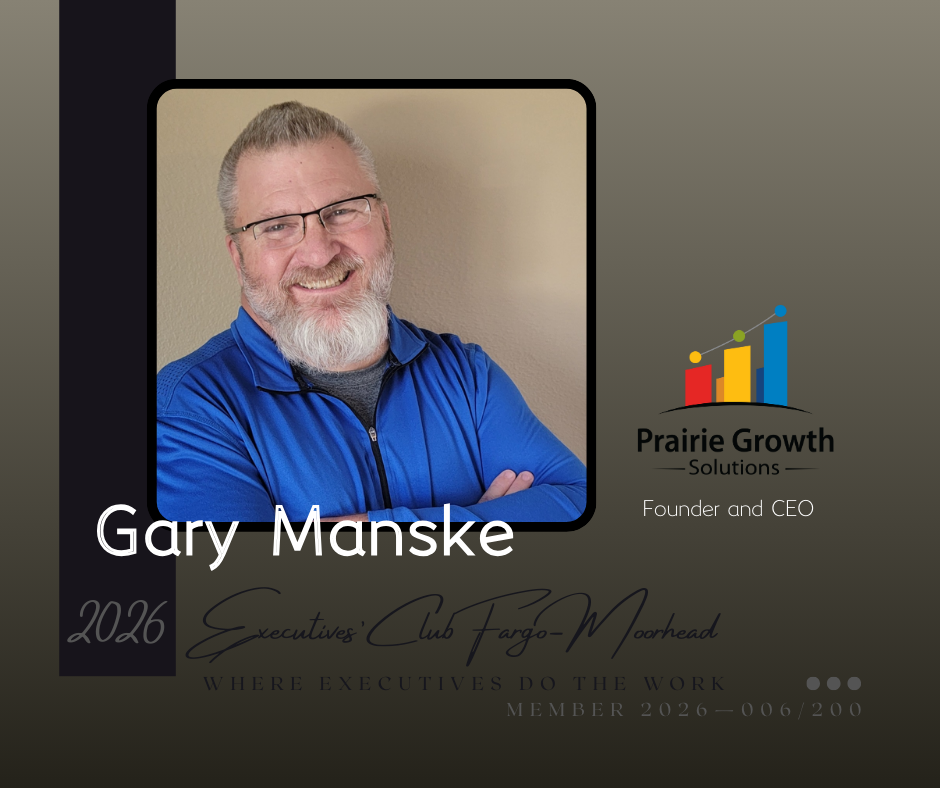
Gary Manske, Founder and CEO
Prairie Growth Solutions, LLC
West Fargo, ND 58078
Business: 701-809-0101
Cell: 701-306-1928
Hometown | High School | College(s)/University:
Onalaska High
Western Wisconsin Technical College
Western Governors University
Gary Manske is the CEO and founder of Prairie Growth Solutions, a business coaching and strategy firm helping small and mid-sized companies achieve profitable, scalable growth. Gary specializes in turning business complexity into actionable, numbers-driven plans that deliver results. With decades of experience in strategic leadership, sales, marketing, and operations, Gary is recognized for his practical, execution-focused approach and his ability to help owners and leadership teams clarify their path, improve margins, and build systems that support sustainable growth.
Gary’s work goes beyond advice—he engineers profit acceleration through proven frameworks, strategic planning, and hands-on coaching. Whether it’s one-on-one consulting, group coaching, or leveraging proprietary tools like Profit Acceleration Software™, Gary equips clients to unlock new revenue, convert more prospects, and drive measurable improvements without adding chaos or complexity.
Community Involvement:
Gary Manske’s approach to community impact is hands-on, strategic, and deeply rooted in creating sustainable change for vulnerable and underserved populations. His service combines leadership, mentorship, and practical problem-solving—often focusing on those who are overlooked or facing significant barriers.
Key Roles & Initiatives
Founding Board Member, Peace Officers / Jail Chaplains Association (Fargo, ND):
Helped establish and fund this organization, which supports the rehabilitation and reintegration of current and former inmates at Cass County Jail. Gary’s work focused on creating programs that address real barriers to independence, providing hope and practical pathways for those re-entering society.
Board of Deacons Treasurer, First Assembly (Fargo, ND):
Provided financial oversight, strategic direction, and leadership as an officer and board member. Gary’s role included ensuring the organization’s financial health and aligning resources with its mission to serve the broader Fargo community.
Youth Development & Mentorship:
Founding board member of Excellerate Youth (Fargo, ND), a nonprofit helping teens aging out of foster care develop life skills, build support networks, and overcome barriers to independence.
Founding board member of Hip Hop and Hope, using music, arts, and mentorship to create pathways for at-risk youth.
Community Education & Advocacy:
Regularly leads workshops, financial training, and business education for small business owners and community members, equipping them with tools for growth and self-sufficiency.
Advocates for using business as a force for good—helping others leverage entrepreneurship to create positive change in their communities.
Guiding Philosophy
Gary’s community work is driven by a belief in “scorecards, not slogans”—measuring impact by real outcomes, not just intentions. He prioritizes transparency, accountability, and sustainable solutions over quick fixes. Whether serving on boards, responding to disasters, or mentoring the next generation, Gary’s involvement is always grounded in practical action, empathy, and a commitment to empowering others.
1. Looking back at your career, what decision truly changed the course of your business—or your life as a leader?
In my first professional role, I made another critical decision: I was determined not only to contribute as an employee, but to lead. This mindset shift moved my focus from task completion to understanding team dynamics, motivation, and the mechanisms by which results are achieved through others.
The most transformative lesson in my leadership journey came with the realization that effective leadership is not about making decisions for others and expecting compliance. Instead, it is about guiding teams to reach their own conclusions, fostering ownership and independent thinking. This approach has fundamentally changed the way I lead—evolving from directing individuals to developing leaders—and continues to inform how I build businesses and teams today.
2. If your business disappeared tomorrow, what problem in your industry or community would go unsolved?
My work bridges the critical gap between theory and real-world execution. I enable owners to see their entire business on one page, make confident decisions, and lead teams that are aligned, accountable, and focused on results—not just activity. Without this level of hands-on, strategy-driven coaching, too many promising local businesses would remain stuck—working harder than ever, but with little clarity, limited control, and unrealized long-term profitability.
3. What’s one “business rule” you follow religiously, no matter what?
One business rule I follow religiously is: “Clarity before action.” No matter the situation, I never rush into execution without first ensuring absolute clarity—on objectives, metrics, roles, and expected outcomes. I’ve seen too many teams mistake activity for progress. By demanding clarity up front, I make sure every decision, every initiative, and every investment is anchored to a defined purpose and measurable result. That discipline is what consistently drives real, sustainable growth.
4. What’s one “business rule” you tend to ignore—or break—because it just doesn’t fit reality for you?
One “business rule” I tend to ignore is the idea that you should “never mix business with personal.” In reality, the most effective and enduring business relationships I’ve built are rooted in genuine trust, shared values, and personal connection. While I maintain clear boundaries and professionalism, I’ve found that treating people as whole individuals—rather than just roles or transactions—leads to stronger teams, better client outcomes, and a more resilient business. For me, business is always personal, because that’s where real commitment and accountability come from.
5. What’s something your business had to stop doing in order to actually move forward?
One thing my business had to stop doing in order to move forward was trying to be all things to all people. Early on, it was tempting to chase every opportunity and adapt to every client request, but that approach only led to diluted focus and inconsistent results. By narrowing our scope—focusing on the clients and problems where we deliver the most value—we gained clarity, built stronger systems, and created far greater impact. Specialization, not generalization, is what drives real progress.
I still need to remind myself of this daily.
6. Think about your blind spots. Which one challenged you the most, or are you still working on today?
The blind spot that’s challenged me most—and one I’m still working on—is assuming others see the big picture as clearly as I do. As a leader, I often move quickly from strategy to execution, but I’ve learned that not everyone is on the same page unless I slow down and communicate context, rationale, and expectations. Bridging that gap—ensuring alignment and clarity at every level—remains an ongoing discipline. It’s a constant reminder that leadership isn’t just about vision; it’s about making sure everyone can see and own it together.
7. What’s a lesson you learned the hard way—something no book or mentor could have prepared you for?
A lesson I learned the hard way—one no book or mentor could have prepared me for—is that not everyone wants to grow, change, or take ownership, no matter how clear the opportunity or how much support you provide. Early in my career, I believed that with the right tools and encouragement, everyone would step up. The reality is, some people resist accountability or prefer the comfort of the status quo. Accepting that—and learning to focus my energy on those who are ready and willing—was a tough but necessary shift. It’s made me a more effective leader and steward of both my time and my team’s potential.
8. Which early belief about leadership or business turned out to be completely wrong, in your experience?
An early belief I had was that leadership meant having all the answers and making the key decisions myself. Over time, I learned that real leadership is less about directing and more about empowering others—creating the space for people to think, contribute, and take ownership. The most effective teams aren’t built by the smartest person in the room, but by a leader who asks the right questions and trusts others to help find the answers. That shift changed everything about how I lead and grow a business.
9. What’s one boring, unglamorous habit your business does consistently that you credit with long-term success?